I take my text :-) from John 6:60 (Amplified Bible)
I haven't been back to Starlight Cathedral in about three weeks. The last service I attended really did a number on me. I said (see below) that it aroused "memories of far too many years of legalistic church life." That was something of an understatement.
Mother Hughes said of the Church, "This is the hospital." Healing and curing are not the only things that happen in hospitals; there is also pain, trauma, fatigue, and the prospect of mortality.
Medicine does not always work easily, painlessly, or "naturally." Medicine includes surgery, bone setting, and chemotherapy. Nobody looks forward to any of this. Nobody looks forward to pain.
Medicine also includes misdiagnosis. There are many diseases, once thought to be common and treated aggressively, which are now known not to exist. There are whole classes of treatment which are now known to be ineffective.
Maybe there is such a "disease" as "sin." That doesn't mean it can't be misdiagnosed. That doesn't mean that treatment for it can't be mis-prescribed.
I know most people need some kind of "fixing." But I also know -- from experience -- that to the pure, all things are pure.
Now, I realize that the scripture I just cited is about not overthrowing "the work of God" for the sake of physical pleasures. But I'm not sure it's that easy to overthrow the work of God, or disconnect from -- you know, a phrase like "the love of God" just isn't strong enough! But that's another Sermon I'll Never Preach :-)
What I mean to say, at least this time, is that there are other ways of overthrowing the work of God in the name of preserving it. ("We had to destroy the village in order to save it." Or, to put it biblically, "Let no one defraud you by acting as an umpire and declaring you unworthy and disqualifying you for the prize, insisting on self-abasement.")
To put it bluntly, my life has convinced me that many of the things that even the Bible calls "unclean" may be beneficial. I realize that when the apostle Paul said that "to the pure, all things are pure," he was talking about the Holiness Code of the Old Testament. He did not have in mind gay rights, medical marijuana, or religious pluralism, any more than America's Founding Fathers had those things in mind when they wrote the Constitution. But I believe history has proven that those things are latent in the Constitution and in the Bible.
I don't know how to develop this any further, not today.
It's all about the law of Love, people.
Showing posts with label church. Show all posts
Showing posts with label church. Show all posts
Sunday, October 7, 2007

Wednesday, September 19, 2007
Fruit Feast
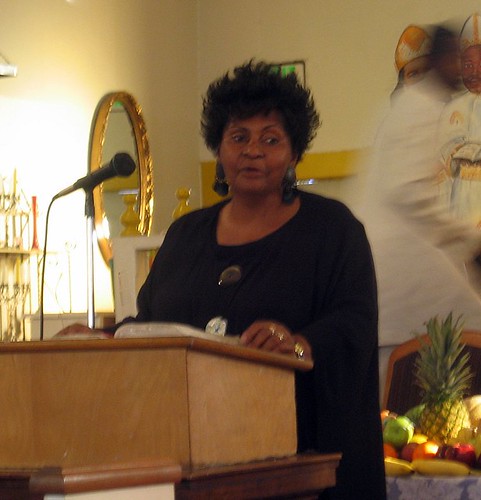
The Fruit Feast was not what I expected. (It is not the same as the Back Hawk Feast, for one thing; at least not in the Bay Area – either that or Jason Berry was wrong.) Nine speakers were invited to discourse briefly on the fruits of the Spirit, but most of it aroused (for me) unpleasant memories of too many years of legalistic church life. However, there were a few highlights that just about made up for it: the pastor of a local church, one Mother Hughes (see blog photo), said that the Lord had taken her "from the crackhouse to the church house," and underlined her few remarks by singing a spiritual: "My soul looked back and wondered / How I made it over." Later – much later – Bishop Hayes discoursed on Faithfulness, and happened to say: "When I was low down, when I was about to be homeless, when I applied to the government for everything on the books [all available social services] and they denied me – they told me No! – I reminded God of my faithfulness all these years" and the situation straightened itself out. (I didn't get a picture of the Bishop, because my camera batteries had wimped out by that time.)
See, here's where I'm on tenterhooks with the church: they hammer on "obedience to the Word" interpreted literally, on a "holy life" defined in apparently fairly conventional terms, and then they'll say something earthshaking and egalitarian like that.
Well, Miss Brenda (a card reader I met last year at Lucky Mojo) did tell me last year that the best church home for people like us is "where Moses went" – the wilderness!
I'm staying home next Sunday – possibly for several Sundays – and if/when Pastor asks about it, I'll just remind him that Jesus advised us, "When you pray, go to your own room." I'm sure he'll take that in good part. After all, it was he who told me a few weeks ago to be exactly what I am.
Sunday, August 26, 2007
Starlight Cathedral, Oakland CA
Today I enjoyed (mostly) a Bible-literalist sermon with very little thou-shalt-not in it. Pastor Franklin is a long, lean man with a lively, commanding manner and an intelligent eye.
He compared himself to King David at one point: “Yes, I’m a warrior, a fighter. Don’t mess with my kids! Don’t mess with anyone in my church family! But I’m gentle, I’m compassionate [like David was].” Not in a spirit of boasting, either, because he addressed the congregation as “brothers of Jesus” several times. In fact, the first ten minutes or so was about claiming and using the power – “the anointing” – that God has already given us; a sermon that Dr. Kioni could preach off the cuff. “And that’s why I can go into any church – Catholic, Baptist, Religious Science – and praise God, because the Holy Spirit is in my life!” He went on to say more than I wanted to hear about obedience to God and the pastor.
Later he exhorted us to challenge the devil, because “I don’t mind if the devil’s on my track, as long as he’s not on my back – ’cause he doesn’t belong there. If you give the devil a ride, he’ll want to drive!” He called our attention to the story of the Gadarene swine, when Jesus begins the exorcism by demanding: “Who are you?” Which is precisely the question I ask of any unpleasant spirits I meet!
Earlier in the sermon, he redefined “brainwashing” as “being washed clean of pessimism!”
All this time I sat in a chair by the door, meek as a church mouse and conspicuous as a rat in a punch bowl. I was intimidated by the silken rope across the aisle. Even when it was unhooked shortly after I arrived, I didn’t move...
Until the minister invited us to come up and be blessed and prayed for. I was about third in line. The women in front of me were looking for help with finding housing for a large family, health problems, and getting a foster care license (the pastor recognized her as “a visionary” who “could be an inspirational speaker”).
I assumed he knew them all, intimately – but then it was my turn. As he anointed my hands with olive oil, he said, “I see things that you have lost are being restored to you” – which pretty well describes my feelings about Christianity at this point. “I see that you are a wise woman; a humble woman; a woman of God. Be exactly what you are. God’ll work it out. (Which addressed my concerns about being ensnared by obedience again.) Are you trying to move?” I remembered my husband’s desire to leave the city. “Yes, but it’s not on the front burner,” I said. He rubbed the olive oil into my palms and prayed: “Lord, break the shackles on our sister’s business.”
And all this without ever having spoken to me, or overheard me, before.
After me came a woman who was trying to get her son released from Juvenile Hall. The pastor was inspired to tell her what kind of candles to burn: “a red one – the red represents the blood of Jesus; a white one – the white is for purity; and a purple one – for power! The First Lady (his wife) will give you her phone number; call her and she’ll tell you how to dress them.” (Later in the service, the Queen Mother – Archbishop’s wife and pastor’s mother – interrupted her shouts of praise to tell this same woman how to arrange those candles.)
After this, the spirit of the service became more comfortable and informal. First-time visitors to the church where thanked sincerely for coming (and special note was taken of the fact that I had sat down among the congregation after I was prayed for). A final song was sung by the children (all the choir they have, apparently), a collection was taken (the church lined up to contribute, rather than passing the plates), and announcements were made: the Harvest Feast is next month – and it is, apparently, the same Fruit Feast in honor of Black Hawk that was mentioned in Jason Berry’s book. Black Hawk was not mentioned, but the First Lady explained to me: it’s a celebration of the “fruits of the spirit,” at which nine people get up and say a few words about one of them (“We’re looking for nine people,” she told me meaningfully) and the congregation is given blessed (literal) fruit to enjoy. It reminded me of the Unitarian Universalist flower communion, and I told her so. “Well! That’s something we could do here,” she said.
Monday, May 28, 2007
Lord Buckley vs. St. John of the Cross
Well, some good idea-candy today. I've been reading about the sins of mysticism tonight, and I see this:
But I wonder. Watch this clip of my favorite preacher, Lord Buckley, and see if you don't catch him describing the love of God overtaking someone right in the middle of a sinful act.
Purgation is the cleansing stage which begins with self-examination and penitence and leads to a holy life. Sixteenth-century monk, St. John of the Cross, is best known for his description of this stage which he called the “dark night of the soul.” During the dark night the soul of an individual feels abandoned by God, spiritually dry and at the point of despair. John saw this as a way in which God purified the soul by suffering, for only when the soul has been purified is it in a position to experience a rapturous union with God. This purgation involved detachment from the things of the world including material and physical desires; and mortification, the building of new paths to replace the old ones now rejected.
But I wonder. Watch this clip of my favorite preacher, Lord Buckley, and see if you don't catch him describing the love of God overtaking someone right in the middle of a sinful act.
Subscribe to:
Comments (Atom)


